1The question we never ask ourselves
When buying olive oil, we check the cultivar, the acidity, and the harvest year. We rarely look at the container with the same attention. Yet, that is where the oil will spend the next 12 to 18 months—and the surrounding material determines how quickly it will degrade.
It is not an aesthetic choice. It is chemistry.
2The problem of light: photo-oxidation
The number one enemy of EVOO is light. When light—whether solar or artificial—hits the oil, it excites the chlorophyll molecules in the extra virgin olive oil (the ones that give it its green color). This excited chlorophyll transfers energy to dissolved oxygen, creating singlet oxygen: a highly reactive form that attacks the double bonds of unsaturated fatty acids and kicks off the lipid oxidation chain.
This process is called photo-oxidation, and it is much faster than normal thermal oxidation. A clear glass bottle exposed to direct sunlight can seriously compromise the oil within just 2 to 3 weeks.
3The dark glass bottle: good, but not perfect
Dark glass—deep green or amber with a UV filter—is a decent solution. It blocks a good part of the light spectrum responsible for photo-oxidation and offers absolute chemical inertness: glass does not leach anything into the oil, even in the long run.
The issue is that "dark" does not mean "opaque." Many dark green bottles still let some light through, especially if kept near windows or under strong fluorescent lights. And there is a second limitation: glass is heavy, it breaks, and every time we open and close the bottle, the oil comes into contact with air.
As the oil level goes down, more air remains inside—and that air continues to slowly oxidize the contents.
4The tin can: why connoisseurs prefer it
Tinplate—steel with a neutral internal coating—is the preferred container for serious millers and professional tasters. The reasons are practical:
- Absolute opacity: zero light passes through the metal. The photo-oxidation problem is eliminated at the source.
- Almost total oxygen barrier: a sealed tin can limits gas exchange better than glass.
- No chemical migration: the internal linings of modern tinplates are certified for prolonged food contact with fats—no release of plasticizers or unwanted compounds.
- Robustness: it does not break, it is easy to transport, and it is more practical to store in the cellar.
The only real disadvantage is that once a large tin can is opened, if you consume it slowly, the air inside gradually increases. The workaround is simple.
5The practical method: large tin + small cruet
The setup that professionals use in the kitchen is this: you buy a 3 or 5-liter tin (the format offering the best value for money), keep the tin closed in the pantry in the dark, and every few days refill a small, opaque ceramic oil cruet of 150-250ml to keep on the countertop.
The tin remains closed almost all the time with very little oxygen inside. The cruet is emptied quickly—fast enough to give oxidation no time to cause serious damage.
This approach beats both the transparent bottle on the kitchen counter and the large dark glass bottle opened weeks ago.
6And the transparent bottle?
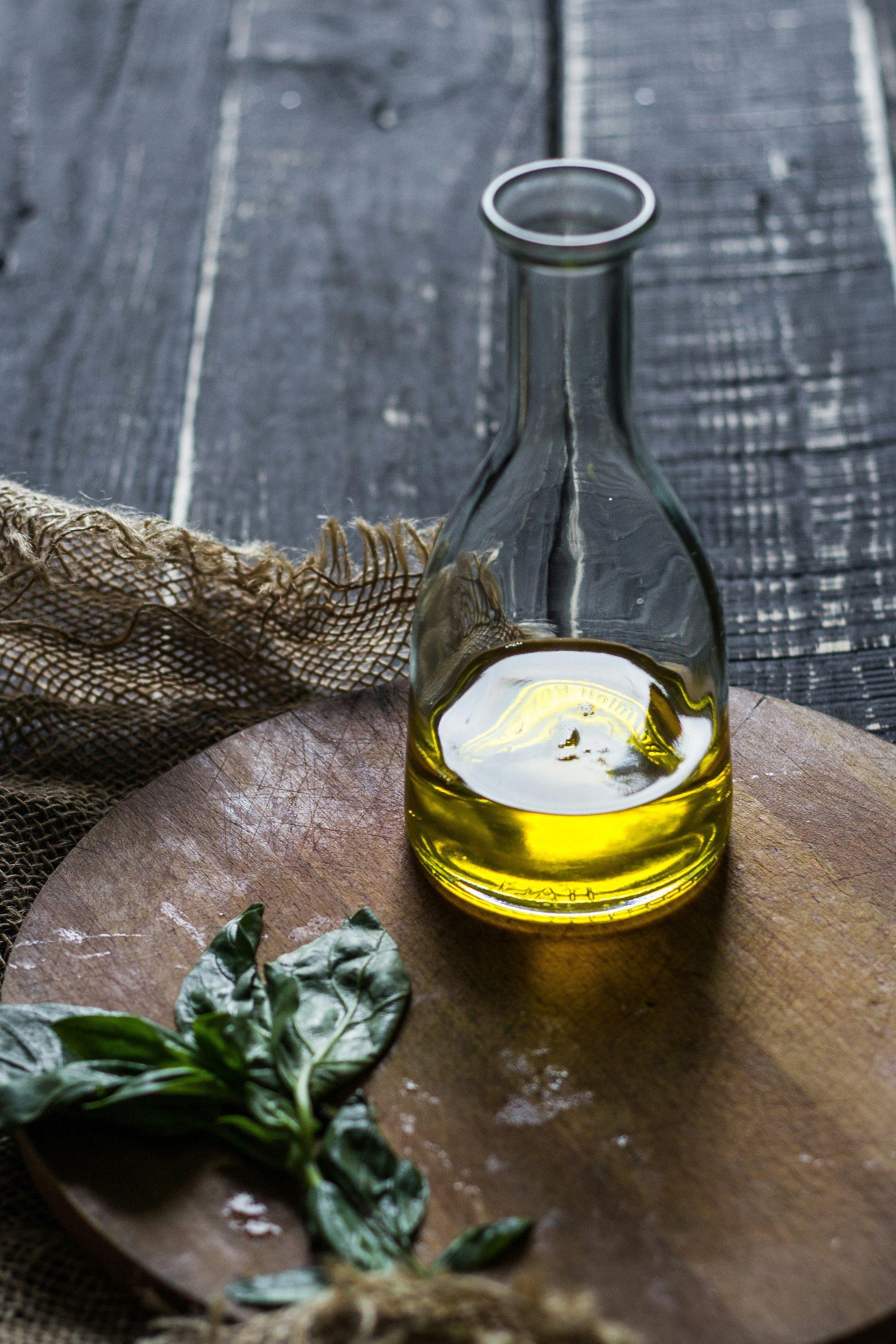
It is great for photography. For storing olive oil, it is useless.
If your oil is in a clear bottle exposed to light, you are losing polyphenols and quality every passing day. This is not alarmism—it is oxidation.
Our 3 and 5-liter tins
EVOO from Frantoio del Pasqua, harvest campaign indicated, optimal preservation guaranteed.
Go to shop →- 1.Frankel E.N. (2011) — Nutritional and Biological Properties of Extra Virgin Olive Oil. Journal of Agricultural and Food Chemistry
Analisi dettagliata dei meccanismi di degradazione dell'olio EVO, inclusa fotossidazione e ossidazione termica.
- 2.Pristouri G. et al. (2010) — Effect of packaging material headspace, and storage conditions on quality indicators of extra virgin olive oil. Food Control
Studio sperimentale sul confronto tra diversi materiali di packaging (vetro, PET, lattina) e loro effetto sulla qualità dell'EVO nel tempo.
- 3.Reg. UE 29/2012 — Norme di commercializzazione applicabili all'olio d'oliva
Normativa europea che definisce i requisiti di imballaggio e confezionamento per l'olio d'oliva extravergine.
- 4.Lerma-García M.J. et al. (2009) — Prediction of olive oil sensory scores by means of near-infrared spectroscopy. Food Chemistry
Evidenza scientifica della correlazione tra esposizione alla luce e degradazione dei parametri qualitativi sensoriali dell'olio EVO.